
Local Government Reform
Latest update (30 June)
Western Bay of Plenty District Council will continue work on two potential merger scenarios as part of the Government’s Head Start pathway for local government reform.
At the 30 June meeting, Councillors agreed to continue assessing options for a Head Start proposal, narrowing the potential scenarios from five to two. These being:
- A Regional Unitary Authority covering all councils in the Bay of Plenty region (Western Bay, Tauranga City, Rotorua, Kawerau, Whakatāne, Ōpōtiki), plus Bay of Plenty Regional Council functions
- A Sub-Regional Unitary Authority covering Western Bay of Plenty District Council and Tauranga City Council, plus Bay of Plenty Regional Council functions.
Both scenarios will also consider the potential inclusion of Thames-Coromandel District Council as part of further investigation.
Next steps
Council will now investigate the two scenarios to help councillors make a final decision 6 August, rather than detailed analysis at this point.
This will include continuing discussions with neighbouring councils over the coming weeks to better understand what options may be achievable against the Government’s criteria.
While the work underway is focused on developing a high-level outline proposal only, more detailed analysis - including financial modelling, service delivery impacts, and representation - would only occur if a proposal is accepted by Government.
A final decision on whether to submit a proposal will be made at the 6 August Council meeting, ahead of the 9 August Government deadline.
Community conversation - COMPLETED
Between Monday 25 May and Sunday 14 June we held a community conversation on whether Western Bay should stay largely as it is, or join with other councils in the future.
This included an online submission form and six in-person sessions right across our District - from Waihī Beach to Maketū. You can read our discussion document here
Thank you to everyone who took part and provided their views. People understand this is a complex process, and while Council doesn't have every detail or every answer yet - they still showed up, asked thoughtful questions, and been willing to work through what this could mean in practice.
While feedback is still being formally analysed, early themes from across the District highlight a strong interest in ensuring future arrangements:
- Maintain a strong local voice and representation
- Reflect the unique mix of rural and urban communities
- Provide value for money and sustainable services
- Keep decision-making close to the communities it affects
Alongside this, a key concern raised through discussions has been the potential for communities to take on costs or debt from other areas and councils.
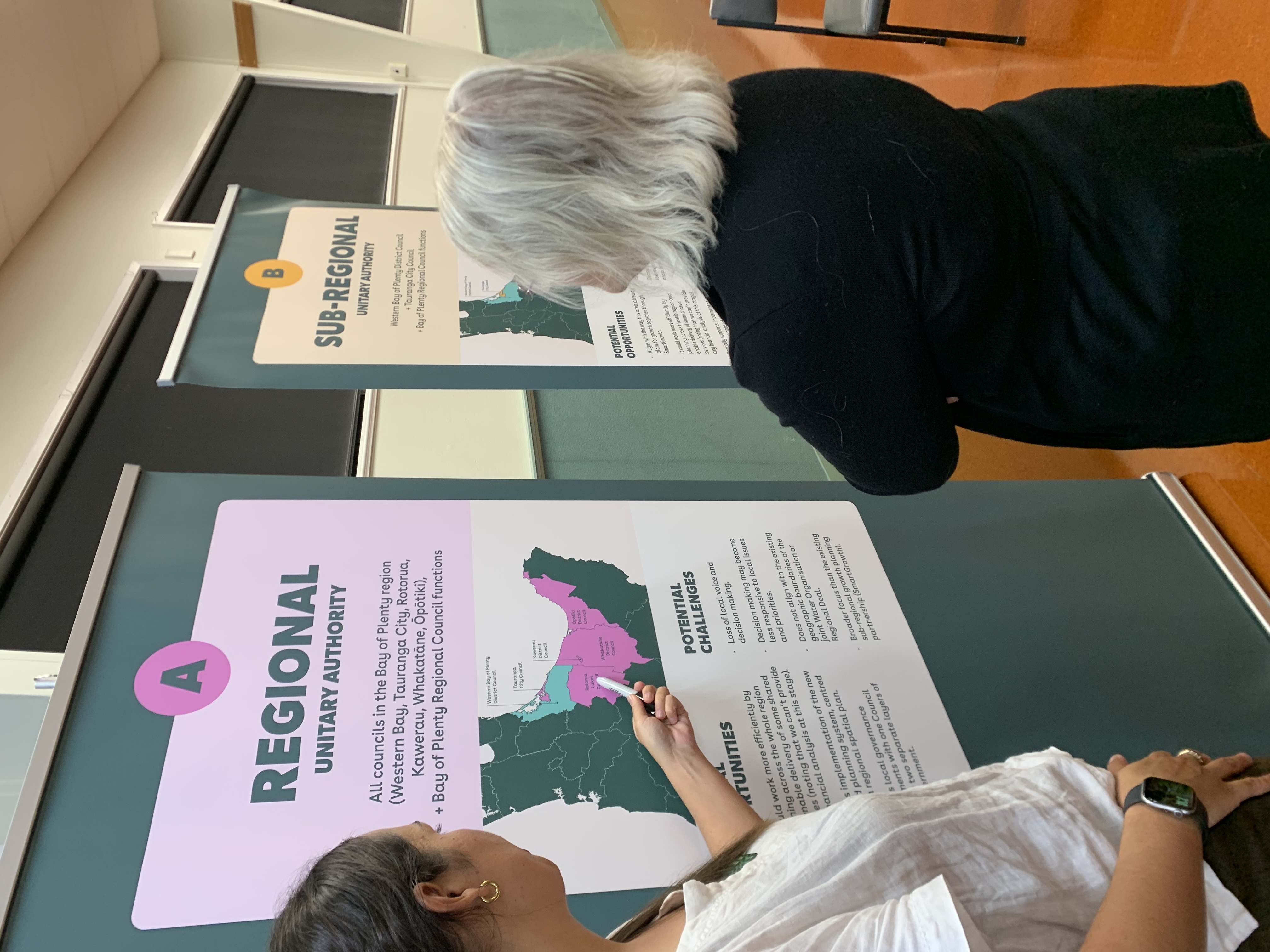 Ōmokoroa Local Government Reform workshop
 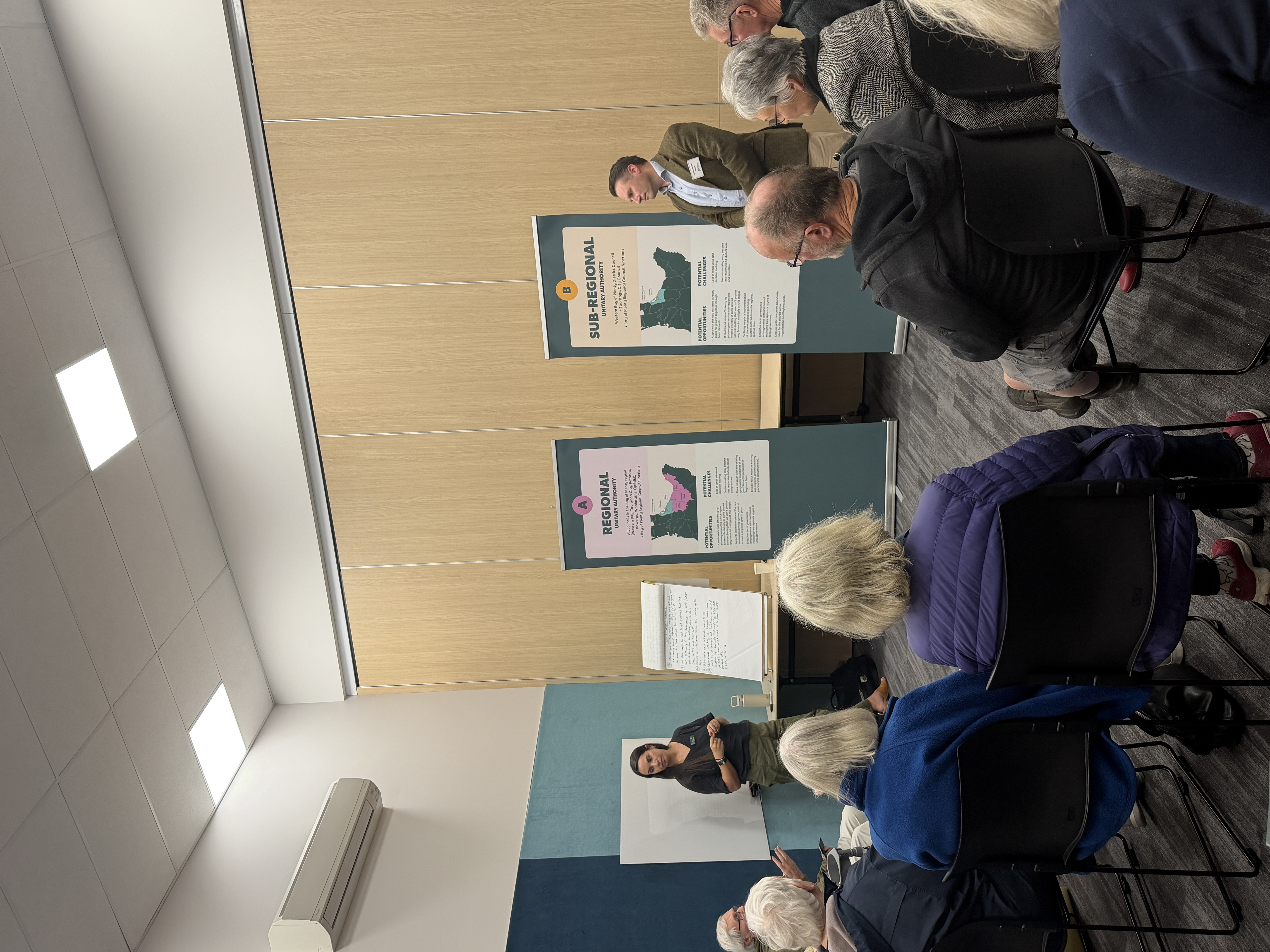 Katikati Local Government Reform workshop
Council will now analyse all submissions and feedback received, consider the key themes and priorities raised by the community, and use this to inform its position on any potential future proposal.
Council is scheduled to hold a formal meeting on Thursday 30 July to discuss government’s head start pathway and decide on whether to submit a proposal before the 9 August deadline.
What is this all about?
Change is coming to how local government works.
The current Government has made it clear that regional councils won’t exist after 2028 and, in line with this, it wants to reduce the number of city and district councils across New Zealand. This gives councils a very short timeframe to consider reorganising themselves before decisions are potentially made for them.
For many people, that immediately raises pātai (questions) about what this means for the future of Western Bay of Plenty District Council.
There are a number of options to consider, with some scenarios keeping decisions close to home, while others involve working with neighbouring areas at a larger scale. Each comes with trade‑offs for local voice, representation, cost, and how closely decisions reflect local needs.
The future shape of local government will ultimately be determined by central government - but our job is to make sure the voice of Western Bay is clearly heard before those decisions are made.
Watch the following recording of Western Bay Mayor James Denyer and Council CEO Matt Potton outlining the process and the possible scenarios followed by answering questions submitted from the community.
Western Bay's scenarios are:
- Regional unitary authority – all councils in the Bay of Plenty region (Western Bay, Tauranga City, Rotorua, Kawerau, Whakatāne, Ōpōtiki) reorganise to become one unitary authority that carries out all the functions of both local and regional council.
Sub-regional unitary authority – Western Bay of Plenty District Council and Tauranga City Council reorganise to become one unitary authority that carries out all the functions of both local and regional council, within the existing Western Bay and Tauranga City boundaries.
Provincial unitary authority – Western Bay of Plenty District Council and other district councils in the existing Bay of Plenty region (Rotorua, Whakatāne, Kawerau, Ōpōtiki, not including Tauranga City) reorganise to become one unitary authority that carries out all the functions of both local and regional council.
District split – the Western Bay is split, with different parts of the District joining different councils. For example, Western Bay could be split into East and West areas based on current known geographic boundaries, and each of these areas could join with their neighbouring councils.
Western Bay unitary authority – Western Bay of Plenty District Council doesn’t join with any other councils, but takes on the functions of the Bay of Plenty Regional Council that can best be delivered locally. A region-wide Council Controlled Organisation (CCO), jointly owned by other councils in the Bay of Plenty, is formed to take on those functions that are better delivered regionally. Some functions could be delivered at a national level. Note: While a Western Bay unitary authority does not fit the current Government’s criteria for the Head Start pathway, this option has been included to inform future decision making by Council.
What is this all about?
The current Government on 5 May 2026 announced a new Head Start pathway, giving councils the option of putting forward proposals for how local government could be reorganised in the future. Councils have until 9 August 2026 to do this.
The Head Start pathway gives councils an early opportunity to propose their own preferences for regional reorganisation into unitary authorities (combining regional and local council responsibilities).
There are a few conditions attached: two or more local councils (not regional councils) are required to work together on the proposal, and the proposal can incorporate other councils, whether they agree with the proposal or not.
Head Start proposals would be in place for the 2028 elections.
Those that choose not to be part of the Head Start pathway will continue through to the 2028 elections, under the Backstop process. This involves the Government reorganising existing councils into unitary authorities.
What we know:
There will be an emphasis on unitary authorities
Regional councillors will be replaced in 2028, with more detail to come through further legislation
An inter-regional scenario could be possible in addition to the scenarios set out in this document. This would need to be considered on a case-by-case basis however with the information currently at hand this would not align with Governments new proposed planning system
What we don’t know
Due to the limited Head Start timeframe, the financial implications for different scenarios remain unclear at this stage.
Future direction could shift if there was a change in government or political appetite for reform changes
